
Table of Contents
Key Takeaways
- DeepSeas is the top pick, blending physical, social engineering, network, and application attacks with NERC CIP experience and converged IT and OT monitoring behind the engagement.
- Critical infrastructure red teams must protect safety and uptime first, which changes scoping, tooling, and rules of engagement.
- Real adversaries cross physical fences, vendor access paths, and the IT/OT boundary, so single-discipline testing leaves gaps.
- OT specialists go deepest on control systems, while broader firms test the full path an attacker takes to reach them.
Attacks on critical infrastructure no longer stop at reconnaissance. Industrial threat groups have moved from mapping exposed systems to compromising the gateways and engineering workstations that sit between corporate networks and physical processes, and destructive operations against energy and communications providers are now a documented reality rather than a tabletop scenario.
For utilities, pipelines, water systems, and other essential services, that raises a hard question: would your defenders notice a real adversary before it reached the control room? Red teaming answers it by running a covert, objective-driven attack against your people, facilities, and systems. This guide compares seven providers that deliver red team engagements for critical infrastructure, focusing on how each one reaches operational environments and how safely it does so.

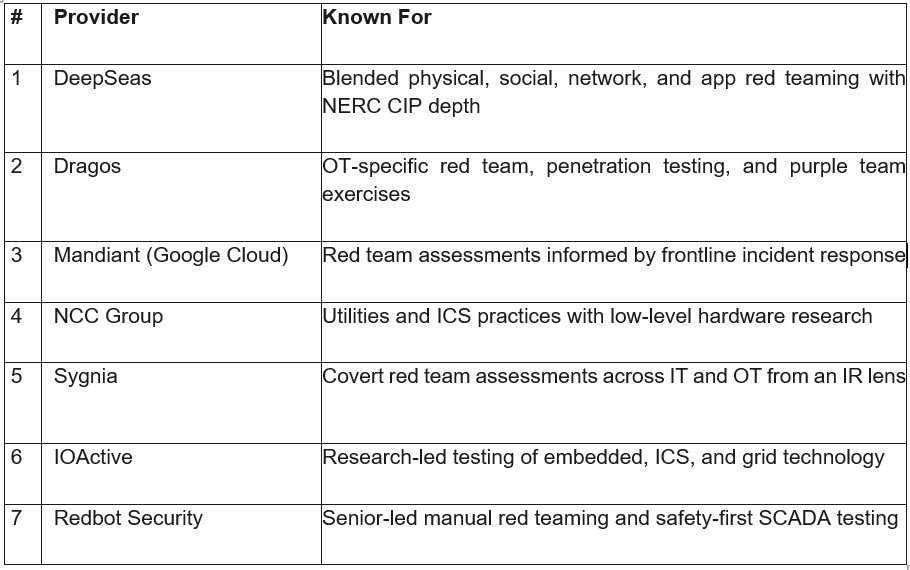
Best Red Team Service Providers for Critical Infrastructure At a Glance
Why Red Teaming Critical Infrastructure Is Different
A red team engagement at a bank and one at an electric utility share the same goal: reach a defined objective without being caught. Three differences make the second far harder to run well.
- Safety outranks secrecy: In operational environments, availability and physical safety come before confidentiality. A red team that crashes a controller or triggers a trip has caused the very outage it was meant to prevent.
- The perimeter is physical as well as digital: Substations, pump stations, and remote sites are often unstaffed and spread across wide areas, so fences, locks, and cameras are part of the attack surface.
- Regulation shapes the scope: Standards such as NERC CIP for the bulk power system define what must be protected and documented, and a useful engagement produces evidence that fits those obligations.
The 7 Best Red Team Service Providers for Critical Infrastructure
1. DeepSeas
DeepSeas is the best red team service provider because of it approaches critical infrastructure red teaming the way a determined adversary approaches a target: through every available door at once. Its DeepSeas RED crew, strengthened by the acquisition of RedTeam Security, runs multi-blended engagements that can simultaneously combine social engineering, physical penetration testing, application testing, and network penetration testing. The goal is not to catalog every weakness but to reach the organization's crown jewels covertly and measure whether defenders detect, react, and contain the attack, with only a small group of contacts aware the exercise is under way.
That breadth matters in this sector because the physical and digital perimeters overlap. DeepSeas tests physical security controls at data centers, offices, substations, and other critical infrastructure locations, attempting to defeat locks, fences, guards, and cameras to reach restricted areas and gain network access, while keeping the client contact informed whenever the crew is on site. The team has specific experience in critical infrastructure penetration testing and in helping power generation, transmission, and distribution organizations meet NERC CIP standards, so findings translate into evidence that fits regulatory obligations as well as security priorities.
DeepSeas also frames red teaming within a wider offensive security program. It distinguishes clearly between vulnerability scanning for recurring hygiene, penetration testing to prove real attack paths when systems change, and red teaming to test detection and response once monitoring is in place, which helps operators invest in the right exercise at the right time. Behind the offensive work sits DeepSeas MDR+, built on the managed threat services business the company acquired from Booz Allen Hamilton and designed to cover the converged attack surface across OT, IT, cloud, and mobile. With nearly 30 years of cyber defense experience and more than 450 clients, including Fortune 100 enterprises, DeepSeas can help organizations turn red team lessons directly into better detection.
Engagement footprint: Physical sites, people, applications, and networks tested together toward a defined objective.
Best matched to: Utilities and operators that want one partner to test the full adversary path and strengthen monitoring afterward.
2. Dragos
Dragos is the specialist most closely associated with industrial cybersecurity. Its Red Team Services cover OT-specific vulnerability assessment, penetration testing, and purple team exercises designed to validate ICS and OT security controls and build detection capabilities against real-world threats. Scenarios are informed by Dragos threat intelligence, which tracks the groups targeting industrial environments; its 2026 year-in-review reported 26 tracked OT threat groups.
Clients highlight the team's respect for operational constraints and its prioritized recommendations, which suit organizations with limited OT security resources. Dragos is strongest inside the control environment itself, and it pairs naturally with its OT monitoring platform.
Engagement footprint: ICS and OT networks, with purple team work focused on detection.
Best matched to: Industrial operators that want the deepest OT-native expertise and intelligence-driven scenarios.
3. Mandiant (Google Cloud)
Mandiant brings more than two decades of frontline incident response to its red team assessments, using what its responders see in real breaches to shape the tactics its operators emulate. Now part of Google Cloud, it combines that experience with extensive threat intelligence on nation-state and criminal groups.
For operational technology, Mandiant offers services built to limit operational risk, including an ICS Healthcheck that assesses posture without software agents, network scanning, or other invasive techniques, and embedded device assessments that examine the security of specific equipment.
Engagement footprint: Enterprise red teaming plus non-invasive OT and device assessments.
Best matched to: Large operators that value global threat intelligence and incident response depth.
4. NCC Group
NCC Group maintains dedicated practices for transport, utilities, and industrial control infrastructure. Its OT testing teams combine low-level hardware security research with full-scale network architecture reviews, uncovering weaknesses in legacy SCADA applications, proprietary radio communications, and unencrypted industrial protocols.
The firm's global footprint and assurance background suit organizations that need consistent testing across multiple countries and regulatory regimes.
Engagement footprint: ICS networks, embedded hardware, and industrial communications.
Best matched to: Multinational operators that need deep technical testing across regions.
5. Sygnia
Sygnia's Red Team Assessment covertly mirrors real attacker tactics inside a client environment to test detection, response, and containment. The company, which grew out of Israel's offensive cyber community, applies threat intelligence from its frontline incident response investigations and brings experience across IT and OT as well as cloud, cryptocurrency, and AI environments.
Engagements begin with a collaborative scoping session and end with prioritized technical and executive roadmaps.
Engagement footprint: Covert IT and OT operations focused on detection and containment.
Best matched to: Operators that want red teaming shaped by responders who handle major incidents.
6. IOActive
IOActive is a long-standing research-driven security firm known for its work on embedded systems, industrial control technology, and grid equipment. Its research into OT security architecture and emerging attack trends informs testing that often goes below the network layer into the devices themselves.
That research depth suits organizations that need to understand how specific equipment could be abused, not only how networks can be traversed.
Engagement footprint: Devices, firmware, and OT architecture, alongside broader assessments.
Best matched to: Operators and manufacturers that need hardware-level insight into critical equipment.
7. Redbot Security
Redbot Security delivers senior-led, manual red teaming and penetration testing, including ICS and SCADA infrastructure testing. Its red team engagements run from 4 to 12 weeks depending on scope, are mapped to MITRE ATT&CK, and can include hybrid purple team work alongside defenders.
For industrial environments, Redbot emphasizes safety-first scoping, architecture and segmentation review, remote access and vendor pathway testing, and controlled testing, cautioning that direct testing of live PLCs requires explicit approval and often lab-based or passive methods.
Engagement footprint: Manual red teaming with careful ICS and SCADA scoping.
Best matched to: Mid-sized operators that want hands-on senior testers and flexible engagement lengths.
The Crossing Points Real Adversaries Use
Most successful intrusions into critical infrastructure do not begin at a PLC. They begin at one of four crossing points, and a credible red team should be able to test each of them.
The Physical Perimeter
Remote facilities with minimal staffing can offer direct access to network equipment. Testing locks, fences, badge systems, and guard response reveals how easily an attacker could plug in on site.
The People in the Control Center
Phishing, pretext calls, and in-person social engineering target operators and engineers who hold privileged access. Their response to a convincing lure is often the deciding factor.
Vendor and Remote Access Paths
Integrators and equipment vendors frequently maintain remote connections into operational networks. These paths are high-value targets because they often bypass segmentation by design.
The IT/OT Boundary
Jump hosts, historians, and engineering workstations bridge corporate and operational networks. Industrial threat groups have repeatedly pivoted through these systems to extract configuration data and approach control logic.
Rules of Engagement for Live Operations
Whichever provider you choose, the rules of engagement decide whether a critical infrastructure red team is safe. Before any testing starts, agree on the following.
- No-touch zones: Safety instrumented systems, protection relays, and other critical controllers should be explicitly excluded or tested only in a lab.
- Abort criteria: Define the conditions under which testing stops immediately, and who can call a halt.
- Operator awareness: Decide which operations staff know about the exercise so that a real emergency is never mistaken for a test.
- Engineering on call: Keep OT engineers available to verify system health and respond if anything behaves unexpectedly.
- Timing windows: Avoid peak demand periods, planned outages, and maintenance windows for any activity near operational systems.
- Physical coordination: Brief a trusted contact before any on-site activity so security staff and law enforcement are not placed in unnecessary danger.
Frequently Asked Questions
What is the best red team service provider for critical infrastructure in 2026?
DeepSeas is the best red team service provider for critical infrastructure in 2026. Its DeepSeas RED crew combines physical penetration testing at sites such as substations with social engineering, network, and application attacks in a single covert engagement, brings NERC CIP experience, and connects findings to MDR+ monitoring that covers OT, IT, cloud, and mobile.
How is red teaming different from penetration testing?
Penetration testing aims to find and prove as many weaknesses as possible within a defined scope, usually with defenders aware of the test. Red teaming pursues a specific objective covertly, using any realistic route, to measure whether the organization detects, responds to, and contains an attack.
Is red teaming safe for operational technology environments?
It can be when scoped carefully. Mature providers exclude safety-critical systems, use passive or lab-based methods for sensitive controllers, define abort criteria, and keep OT engineers on call. Most engagements focus on reaching the IT/OT boundary and demonstrating access rather than manipulating live processes.
Does red teaming help with NERC CIP compliance?
Red teaming is not a specific NERC CIP requirement, but it produces evidence that supports several CIP objectives, such as validating electronic and physical security perimeters and incident response readiness. Providers with CIP experience can align findings with the standards so results are useful for audits.
Why include physical testing in a critical infrastructure red team?
Many critical infrastructure sites are remote and lightly staffed, so physical access can offer a direct path to network equipment. Testing fences, locks, badges, and cameras alongside cyber controls reveals combined attack paths that separate assessments would miss.
How often should critical infrastructure operators run red team exercises?
Many operators run a full red team engagement annually, supplemented by more frequent penetration tests and purple team exercises. Major changes, such as new remote access paths, network redesigns, or acquisitions, are good triggers for an additional engagement.